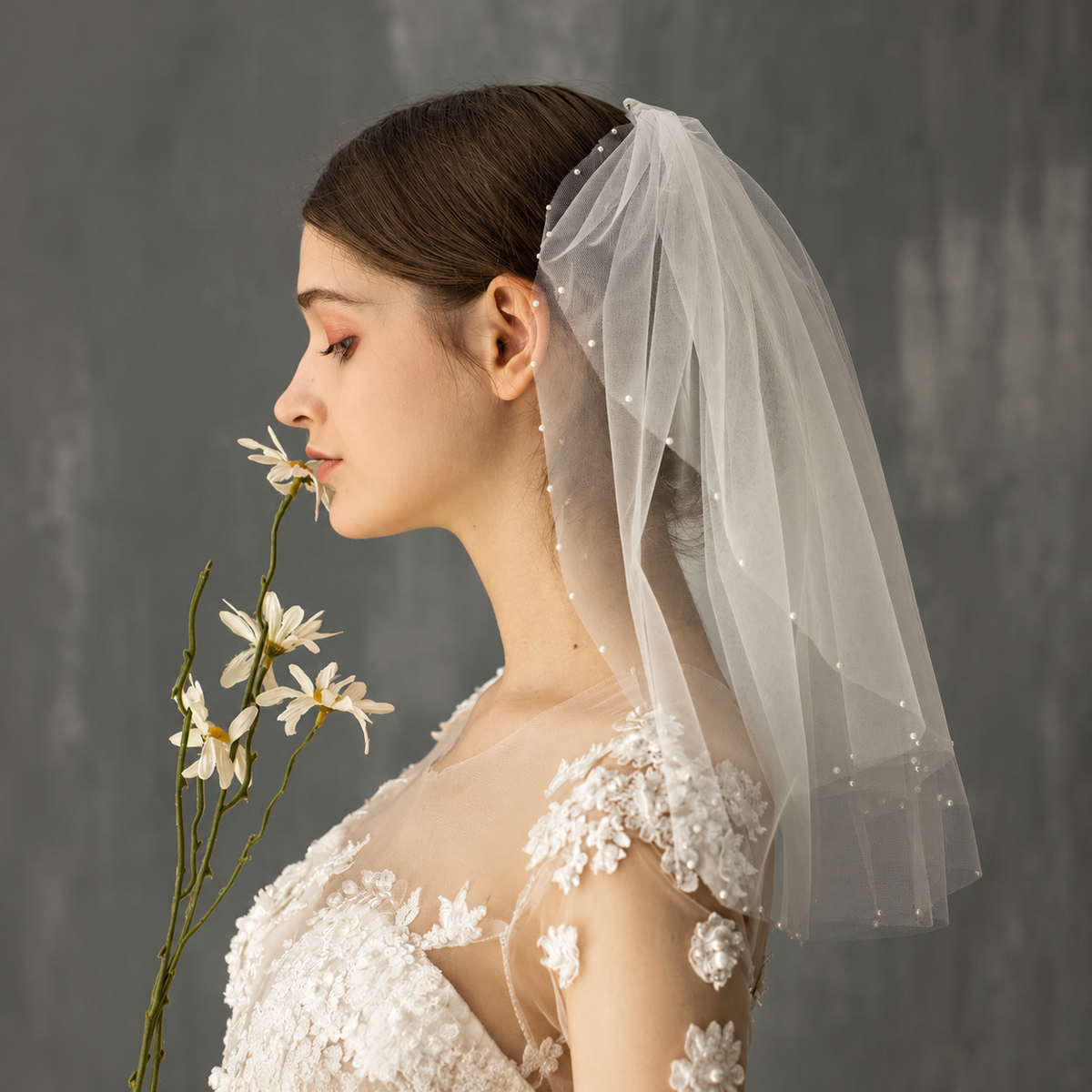
You found your wedding dress. Now you’re comparing veils—and suddenly there are more decisions: ivory or white, pearls or lace, fingertip or cathedral?
Start with what you love most about your gown. Is it the clean silhouette, the floral lace, the open back, or the dramatic train? Your veil can help frame that feature and bring your whole look together.
Here’s how to narrow down your options.
Your Quick Wedding Dress and Veil Pairing Guide
| Your wedding dress | Veil styles to try first | What to check |
|---|---|---|
| Minimalist satin or crepe | Plain tulle, scattered pearls, or a lace-edged statement veil | Whether you want a clean look or added texture |
| All-over lace | Sheer plain tulle or a complementary lace edge | Lace scale, pattern, and where the edging falls |
| Floral or 3D appliqué | Plain tulle or lightly embellished floral veil | Whether overlapping details look too busy |
| Pearl-embellished | Plain tulle or subtle scattered pearls | The combined effect of your dress, veil, and jewelry |
| Open-back or illusion-back | Sheer single-tier or shorter veil | How clearly the back remains visible |
| Ball gown or long train | Chapel or cathedral veil; fingertip for less volume | Actual veil length, width, and venue space |
These are starting points. Try your favorite combination with your dress before making the final decision.
1. For a Minimalist Dress: Choose Your Finishing Detail
A satin or crepe gown gives you room to explore.
For a clean, understated look, try a plain tulle veil. For a little texture, consider scattered pearls. If you want the veil to become a focal point, a lace-edged style can create a more decorative finish around a simple skirt.
Lumibride style to feature: [Insert verified plain tulle veil and pearl veil products.]
Styling tip: If you choose a detailed veil, start with simple jewelry, then add pieces only if the full look needs them.
2. For a Lace Dress: Compare the Patterns Together
A lace veil doesn’t have to match your gown exactly. But the two patterns should feel intentional together.
Compare the size and shape of the motifs. Delicate floral lace and bold geometric lace create different effects. Also check where the veil’s border lands: edging that overlaps the dress can look different from edging that extends beyond the train.
If you love your gown’s lace and want to keep it clearly visible, begin with a sheer, minimally embellished veil.
Lumibride style to feature: [Insert verified sheer veil and lace-edged veil products.]
Before buying: View the veil and dress together from the back, including a full-length photo.
3. For a Floral or Beaded Gown: Give the Details Room
If your dress already has dimensional flowers, sequins, or extensive beading, try a plain veil first. You may find that the transparent layer provides all the finish you need.
For a more decorative combination, look for a veil that repeats one element from the gown—such as a floral motif—without adding several competing details.
Lumibride style to feature: [Insert verified plain veil or lightly embellished floral veil.]
4. For a Pearl Dress: Decide Where You Want the Pearls
Pearls on your gown, veil, earrings, and necklace can create a coordinated look. You don’t have to include them everywhere.
Try two combinations:
-
A plain veil with pearl earrings.
-
A scattered-pearl veil with smaller, simpler jewelry.
Take photos of both. Choose the combination that gives you the balance you want.
Lumibride style to feature: [Insert verified scattered-pearl veil.]
5. For an Open Back: Check Transparency and Placement
If your dress has an open back, illusion panel, or a row of buttons you love, check how the veil falls across it.
A sheer single-tier veil is a useful starting point. A shorter veil can also work, but make sure its edge doesn’t end directly across the detail you want to highlight.
Lumibride style to feature: [Insert verified sheer single-tier or fingertip veil.]
Does Your Veil Need to Be Longer Than Your Train?
No single length works for every dress.
A veil extending beyond the train can create a dramatic outline. A shorter veil can leave more of the skirt visible and may be easier to manage.
Check the actual measurements rather than relying only on names such as “chapel” or “cathedral.” Measure from where you plan to attach the veil, and consider your ceremony space, walking surface, and how much arranging you’re comfortable with.
Should You Choose White or Ivory?
Use your dress as the reference. Color names alone cannot guarantee a match across different brands.
If fabric samples are available, compare them against your gown in daylight and indoor lighting. Look at the tulle both spread out and gathered, since overlapping layers can make its color appear stronger.
Before ordering, check the product’s return terms—especially for personalized pieces.
Is a More Expensive Veil Worth It?
Compare the details you can evaluate: fabric, dimensions, edging, embellishment, attachment, and customization.
A simple veil may give you exactly the look you want. A more elaborate design may be worth the additional cost if its craftsmanship or detailing matters to you.
Choose a budget you’re comfortable with, then judge each veil by how it works with your dress.
Your Final Try-On Checklist
Before committing, try your veil with your gown, planned hairstyle, and jewelry.
-
Check the front, side, and back.
-
Walk, turn, and sit down.
-
Ask your hairstylist how it will attach and come off.
-
Confirm production and shipping estimates against your wedding date.
-
Review the full look in photos as well as the mirror.
Ready to narrow down your options?
Explore https://lumibride.com/collections/wedding-veils and start with the styles that complement the details you love most about your dress.